Below is the text of the lightning talk I gave at Code4Lib 2026 earlier this week, on March 3. The conference venue where I delivered it is located at 1 Dock Street in Old City Philadelphia. Links below go to websites with images similar, but not always identical, to the ones I showed during the talk, as well as to some additional sites giving more context.
If you have a chance, it’s worth walking a few blocks from here to 6th and Market Street, where you can find a reconstructed frame of the President’s House, the home of George Washington during his presidency when Philadelphia was the capital of the US.
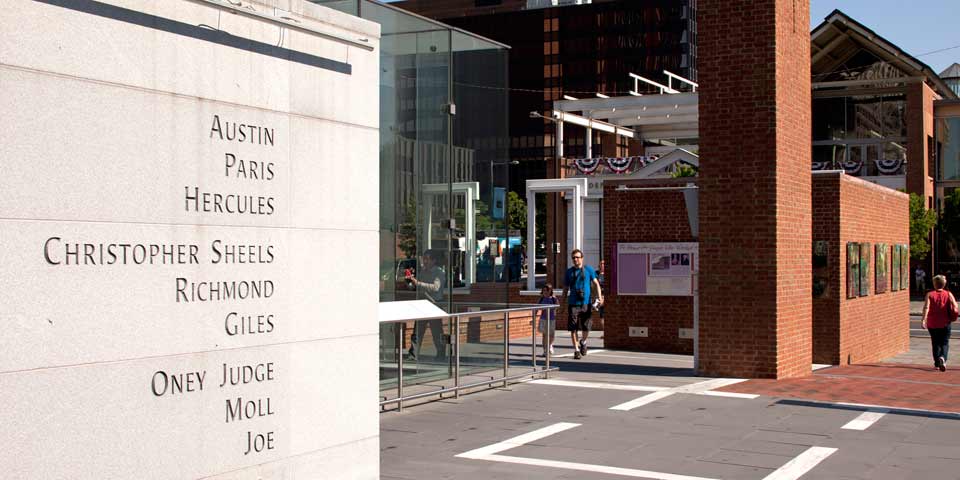
An exhibit went up there some years ago, telling the story of the nine people in his household who were enslaved there. Not long ago, the Trump administration ordered the exhibit be removed. You can see here one of the spaces where its panels were taken down.
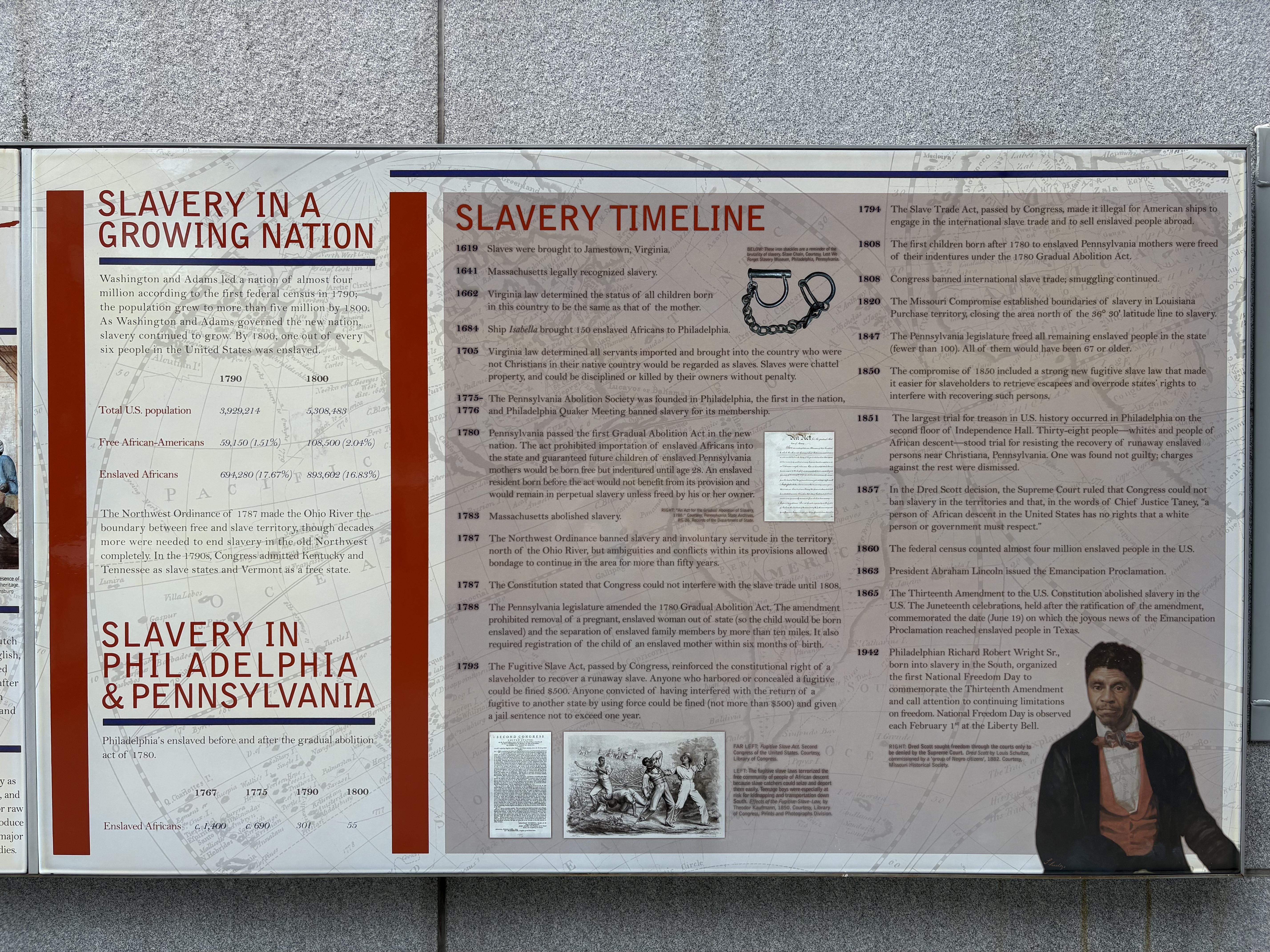
Here’s one of those panels, putting the story of Washington’s slaves in the context of where they lived, and the chronology of their bondage and freedom.
A judge recently ordered that the exhibit be restored. The court battle is ongoing, and the National Park Service has put back some of the panels. while others are still missing. In some of the gaps the public have put up their own signs (some of which you can see in this picture), testifying to what’s been suppressed. If you go there, you might even find someone acting as an unofficial tour guide, telling visitors stories similar to the ones that used to be on the official signs.
Now, we know what those signs said. The folks at the Data Rescue project collected photos of them before they came down, and you can view them online. But the importance of the exhibit is not just what it says, but where it says it. It’s important that it’s embedded in a particular place, so that people who come visit what’s sometimes called the cradle of liberty also find out that there’s a story about the people deprived of liberty here, and about how they won their freedom.
While we’re at Code4lib, we’re also embedded in a rich environment filled with history and culture. Just on your walk from here to the President’s House you might pass by the Museum of the American Revolution, the Science History Institute, the American Philosophical Society, the Weitzman National Museum of American Jewish History, and of course, the Liberty Bell and Independence Hall. There’s all kinds of trails of knowledge you can follow, and it’s even better when you have a guide to those trails.
So what do I mean by a trail? A trail is a designated, visible path designed to help its users appreciate and understand the environment it goes through. You may have hiked some sometimes, and you may have gone on some more explicitly interpretive trails, like the Freedom Trail in Boston.
Our libraries are also rich environments of history and culture. And we provide ways for users to search them, but do we provide trails for them?
Well, we kind of do. We have exhibits, like this one from the Library Company of Philadelphia, providing a guided path through a collection of 19th century works on mental illness. People who teach courses like this one at at Yale create instructional trails in their syllabus reading lists. And books that our scholars and authors write, like this one on the history of the civil rights movement, show an implicit trail of events they cover in their tables of contents.
But while these trails all refer to resources in our libraries, they’re not embedded in libraries in the same way as the exhibits and trails I’ve shown in Philadelphia and Boston. But they could be.
You can think of it as an extension of browsing. Last time Code4lib was here in Philly, I showed how a catalog I maintain lets you browse subjects using relationships in the Library of Congress Subject Headings, so you can explore various related topics around, say, who can start a war. More recently, I’ve added features for finding out more about people and their relationships, using linked data from places like id.loc.gov and Wikidata.
But we don’t have to stop with what’s in authority files, or in generic library descriptions. Maybe in the future, when you’re visiting Martha Washington’s page, you’ll find a trail that goes through it, like a trail telling the story of Ona Judge, one of the African Americans who Martha claimed ownership over, and who escaped from the house at 6th and Market here in Philadelphia, and stayed free the rest of her life.
What will that trail telling her story look like? I’m not quite sure, but I have some ideas that I’m hoping to try implementing, not so that I can tell the story, but that I can represent the story from others who can tell it better than I can. And so that people visiting my site can find and follow that story, with all of its richness, just as they once could when they visited the President’s House in Philadelphia, and as I hope they soon can do here again.
If this interests you, I’d love to talk more with you.

 RSS feed
 Everybody's Libraries