In Grace Taber Hallock’s fantasy The Boy Who Was, Nino, a boy given eternal youth by the Sirens, relates what he’s seen and done in his Italian coastal town over thousands of years, from the time of Odysseus to 1927. The book, with illustrations by Harrie Wood, was one of the Newbery Honor books of 1929.
When this book joins the public domain in 56 days, we’ll be able not only to freely read it, but freely write further adventures of Nino to and beyond the present. #PublicDomainDayCountdown
The posters for the silent drama Love read “John Gilbert and Greta Garbo in LOVE”, playing off both the on-screen and off-screen romance of its two stars. The movie, based on Anna Karenina, was filmed with two endings, one where Anna has the same end as in Tolstoy’s novel, and one with a happier ending. American audiences preferred the latter (and Rick’s Cafe Texan defends it in this review). The film’s copyright (from 1928, despite its 1927 release) happily ends in 57 days. #PublicDomainDayCountdown
Esther Forbes is best known for her books on colonial New England, winning a Pulitzer prize for her biography of Paul Revere, and the Newbery for her novel Johnny Tremain.
Her first book on that era, A Mirror for Witches, is set in the Salem witchcraft craze. Ben Kilpela says her novel conveys “what it really felt and feels like to believe in demons so deeply that it could steer people who so believe into unwitting error.” It joins the public domain in 58 days. #PublicDomainDayCountdown
Five years ago, the US public domain started growing again after a 20-year freeze. In 2019 #PublicDomainDay parties featured 95-year old music like the 1923 novelty song “Yes! We Have No Bananas”.
Sound recordings got longer copyrights, but in 2024 they also start to expire annually, after 100-year waits. In 59 days, the first recordings of “Yes! We Have No Bananas” are among the 1923 records finally joining the public domain. That’s an appealing prospect for our #PublicDomainDayCountdown
Peter Pan debuted on stage in 1904, but the play is not yet public domain. The title character is, due to a 1911 novelization, but the play script, with Peter’s appeal to the audience to clap their hands if they believe in fairies, wasn’t published until 1928. It joins the US public domain in 60 days.
Thanks to much applause for the public domain, another famous character some believed would never join it will get there too. I’ll get to that, and much more, later in my #PublicDomainDayCountdown
The year 2024 is just two months away. It’s a milestone year, not least because a lot of creative works will be entering the public domain, including some very famous ones, and a lot of lesser known ones that have a new chance to be enjoyed, shared, and reused. In the United States, this will include sound recordings first released in 1923, and other kinds of creative works first published in 1928 that haven’t yet joined the public domain here.
As I have for the past few years, I’ll be highlighting a number of these works in a #PublicDomainDayCountdown that will be published here on my blog, and on social media. This year, I’m hoping to publish it in both kinds of places at once. I’ve turned on ActivityPub syndication for Everybody’s Libraries, which should allow anyone else using an ActivityPub-enabled platform, such as Mastodon and other “fediverse” services, to follow posts on their platform as I publish them on this blog. (I’ll also, at least initially, be boosting or republishing them on my Mastodon.social account, to make them more visible.)
I plan to make a separate short post for each day of the countdown, rather than updating the same blog post repeatedly as I have in recent years, since I think that will make it easier to follow on social media as well as on Everybody’s Libraries. But I may adjust how I publish new items as I go along, if I learn of better ways to do it.
Two score and twelve years ago, Michael Hart sat down at a terminal at the University of Illinois and typed in the text of the Declaration of Independence. He shared the file he created with other users of the computer time-sharing system he was using, and spread it over what would eventually become the Internet as we know it today.
Thirty years ago this summer, Robert Stockton decided to adapt some of the electronic texts that Michael Hart’s Project Gutenberg had been putting online, and created some of the first illustrated hypertext books on the then-new World Wide Web. I’d just set up a web server at Carnegie Mellon, where he and I were at the time, and I set up a web page with links to his web editions, as well as to other books from Project Gutenberg and other early electronic text sites. That was the beginning of The Online Books Page, which, like Project Gutenberg, is still going today.
I’ve kept the service going for a number of reasons, some of which I recently discussed in an article Renata Ewing wrote for the University of California’s HathiTrust service. I’ve been motivated in part by the opportunities The Online Books Page provides for prototyping and demonstrating ways to discover, organize, and link information about books and serials (some of which can then be also used to increase the usefulness of library collections more broadly). But I’ve also been motivated by the opportunities to publicize and encourage the work of lots of people who share literature, and knowledge about literature, with readers across the world on the internet.
So many individual people have made a real difference doing that work. It’s not just folks like Michael Hart and Robert Stockton. It’s also folks like Mary Mark Ockerbloom, who shortly after I met her resolved to increase and promote online writings of women, who were grossly underrepresented in early online collections. And it’s many other folks who continue to promote and make available online the writings of many other underrepresented groups. And it’s folks like Charles Franks and the thousands of volunteers at Distributed Proofreaders who work a page at a time to produce the majority of Project Gutenberg’s new releases. (They just posted their 46,000th title this week.)
It’s authors, author’s families, and publishers who freely share their works with others via mechanisms such as Creative Commons licenses, or just by granting permission for free online editions. Some have done so after the works have had their peak sales in the market (like Tom Lehrer, or the families of Leo Edwards and Jan Struther). Some have done so earlier. Many scholars, for instance, now make their work open access upon publication, to maximize the reach and impact of their scholarship. These include the authors of more than 60,000 books listed in the Directory of Open Access Books (now celebrating 10 years online).
It’s folks who share information about books and other works that deserve more attention. Folks like Bob and Molly Freedman who have collected and shared detailed descriptions of Jewish songs and music from all over the world (and whose rich catalog I helped put online some years ago, and will be soon putting back online in updated form). It’s folks like the recently departed Denny Lien who extensively documented the contents of the magazines he collected on sites like FictionMags, and who was one of many people who suggest books and serials to list on my site and make them more visible to the world. It’s the many folks who contributed information to the Deep Backfile project, and others like Greg Cram and Melissa Levine who have helped bring to light the “hidden public domain” of the mid-20th century to make it easier for it to be opened to world in large library projects (as folks like Kristina Hall at HathiTrust and Brewster Kahle at the Internet Archive have then done).
It’s folks who want to make books online more accessible and appreciated by readers. Teachers like Philip Weller, who made Shakespeare easier to understand, publishers like Alex Cabal. who makes elegantly formatted ebooks available for a variety of ebook reading devices and programs, and book lovers like Louise Hope, who adds witty and informed annotations and illustrations to her favorite public domain books, and shares them with the world.
There are many other people I could name, but this post is already getting long. What they all have in common, though, is a desire to share knowledge and artistic creations with the world. In an internet that’s increasingly dominated by a small number of giant corporations exploiting users for profit, these people are sharing knowledge and art online not to monetize it, or mine the personal data of people who read it, or become influencers over millions of followers, but to enrich the lives of their fellow readers. And from one person to another, they’re making a difference, continuing to advance the visions that many of us have had for the internet since it was young.
For all the people who share like this, and for the institutions like mine that support our work, I’m grateful to be in your company. I’m thankful that I’ve gotten to work with you for the last 30 years, and I hope to continue to work with you and appreciate what you do for many more.
(Postscript added July 13, 2023: I want to add thanks to Rebecca Ortenberg, one of my colleagues at the Penn Libraries who just published an article on The Online Books Page for the Penn Libraries news. My co-workers at the Penn Libraries do so much to share books and information resources with people at my institution and well beyond, and I’m fortunate to get to work with them on this project and many others.)
I’m starting my countdown today to Public Domain Day, when a year’s worth of copyrights in many countries expires on January 1. In the US, we’ll be getting works that were copyrighted in 1927, and whose copyrights were consistently maintained since then. I’ll be featuring 60 works, or sets of works, one per day in the days to come. You’re welcome to read and join in.
In recent years, the primary venue for my countdown has been Twitter. Recent events, though, make me less confident in the future of that site as a useful and enjoyable social media platform. When it comes down to it, I’m not all that optimistic about any large-scale discussion forum that’s controlled by the whims of one rich guy. So this year, I’m trying out a new primary venue that’s not subject to any one person or organization. I’ve dusted off an account I created a while back on mastodon.social, and will be posting my countdown first there. They’ll be readable not just on that site, but on any other site that exchanges messages with it using the ActivityPub protocol. That’s a large array of sites, collectively known as the “Fediverse” (for the way that sites federate with each other to do that message exchange), or as “Mastodon” (which, strictly speaking, refers to the open source software used by many, but not all, of those sites). On any federated site you can read and respond to my posts by following or searching the #PublicDomainDayCountdown hashtag (linked here via the mastodon.social website, which can be slow at times). Or follow my personal account, though that will also show you posts I make on other topics, and might not show posts others make using the hashtag.
You can join whatever Fediverse site you like, or join multiple ones. If you later want to move to another Fediverse site that you like better, you can take your follows with you and leave a forwarding address. (I might do that myself after I finish the countdown from my current site.) If you’d like to learn more, Ruth Kitchin Tillman, who co-administers one of those sites, has a useful introductory guide, written especially with library folks in mind. Newcomers, or those who would like refreshers, might also find the documentation on fedi.tips useful. You can also find a large directory of sites to consider, as well as various apps for using them if you don’t want to just use their websites, at joinmastodon.org.
I do plan to continue posting the countdown on Twitter as well, though it might appear in more abbreviated form there due to the smaller character limits for posts, and might appear later than it does in the Fediverse. (Or possibly earlier in some cases; I’m not quite sure myself how long it typically takes posts to propagate through the Fediverse.) [Update: I stopped posting it on Twitter on December 11, for reasons I gave there that day.] And, as usual, I’ll also post and periodically update my countdown here on this site, where the only controlling whims are my own.
Reformatted for my blog, here is my countdown for 2023:
November 2: “Wait a minute- you ain’t heard nothing yet!” said Al Jolson onscreen in 1927, and the movies would never be the same again. Arun Starkey on The Jazz Singer, the first “talkie” feature film, joining the public domain in 60 days. #PublicDomainDayCountdown
November 3: The Hardy Boys was the first multi-generation breakout hit series from the Stratemeyer fiction factory. Leslie McFarlane, its original ghostwriter, writes about taking the job. His first 3 mysteries join the public domain in 59 days.
Many of us read syndicate-revised versions with updated settings and less overt racism, but arguably less interesting prose. In the public domain, we’re all free to both read the originals & adapt them as we like. #PublicDomainDayCountdown
November 4: “An almost mythic tale of a life simply lived in the American southwest” is how the Literary Ladies Guide describes Willa Cather’s Death Comes for the Archbishop, joining the public domain in 58 days. More on the book at the University of Nebraska’s Willa Cather site. You can find bibliographic information and scholarly articles there now; I look forward to them adding full text, as they have for earlier Cather novels. #PublicDomainDayCountdown
November 5: “I ask you very confidentially…”
Jack Yellen wrote the music, and Milton Ager wrote the lyrics, inspired by his daughter (a toddler at the time, later a regular on 60 Minutes).
“…Ain’t She Sweet?”
Published in 1927, it’s been covered by scores of artists, including the Beatles and the Muppets. I’ll sing it to my sweetie when I go out with her this weekend. It’ll be in the public domain in 57 days, and probably in your head right now. #PublicDomainDayCountdown
November 6: Sherlock Holmes fans have reason to rejoice in 8 weeks. Sir Arthur Conan Doyle’s last two Holmes stories, and The Case Book of Sherlock Holmes, join the US public domain then. Not only does this free the complete Holmes canon, but it also frees adapters from worry that Doyle’s estate might shake them down for payment or approval based on claims of copying aspects of Holmes allegedly only in the late stories. (See e.g. this story.) #PublicDomainDayCountdown
November 7: “Who do you think can hold God’s people / When the Lord God himself has said, / Let my people go?”
God’s Trombones consists of James Weldon Johnson’s poetic distillations of sermon themes and preaching styles he often heard in African American churches. It’s notable for Aaron Douglas’s art and design as well as Johnson’s poetry, as the Norman Rockwell Museum shows: https://rockwellcenter.org/essays-illustration/gods-trombones-judgment-day/
November 8: “There are those who foresee the decline of partisan politics in this country,” wrote Dartmouth professor Harold R. Bruce in 1927, “but such people deceive themselves…” His textbook American Parties and Politics, which includes this quote, went through multiple editions. If you’re in the US, you can vote today, and in 54 days when the book’s first edition joins the public domain, you can more easily read it and compare the states of US politics then and now. #PublicDomainDayCountdown
November 9: Virginia Woolf’s To the Lighthouse is on multiple lists of best novels of the 20th century, though not all readers easily get into it. Kate Flint has an introduction, with accompanying content from the British Library, to this “carefully structured, psychologically complex novel that ultimately asks the reader to reflect on their own ever-changing experience of being in the world.” Woolf’s novel joins the US public domain in 53 days. #PublicDomainDayCountdown
November 10: Walter R. Brooks wrote over two dozen children’s books about Freddy the Pig and other remarkably intelligent animals living on the Bean Farm in upstate New York. The series ended in 1958, the year Brooks died, but it continues to have dedicated fans, some of whom run this website: http://freddythepig.com/
Freddy the Pig first appeared in To and Again in 1927. The original edition, illustrated by Adolfo Best-Maugard, joins the public domain in 52 days. #PublicDomainDayCountdown#Bookstodon
November 11: “For those who will climb it, there is a ladder leading from the depths to the heights – from the sewer to the stars – the ladder of Courage.” That title card opens 7th Heaven, a 1927 film set in Paris on the verge of the first World War. Aubrey Solomon writes about it here for the Library of Congress.
This silent film, which earned three of the first-ever Academy Awards, joins the public domain in 51 days. #PublicDomainDayCountdown
Bartók himself played the piano in the concerto’s premiere in Germany in 1927. It joins the public domain in the US in 50 days. #PublicDomainDayCountdown
November 13: Two memorable spinster detectives make their debuts in 1927. In Dorothy L. Sayers’ Unnatural Death (published in the US as The Dawson Pedigree), Miss Climpson goes undercover in an English village to investigate a murder for Lord Peter Wimsey. And Agatha Christie’s Miss Marple begins a decades-long crime-solving career in “The Tuesday Night Club”, a story published in the December 1927 Royal Magazine. Both join the US public domain in 49 days. #PublicDomainDayCountdown
November 14: Hermann Hesse’s Der Steppenwolf focuses on a man getting through severe mental and spiritual crisis. While it had mixed reviews at its 1927 release, it gained new popularity in the social crises of the 1960s, though Hesse then called it “violently misunderstood”.
Hesse’s original German novel joins the US public domain in 48 days. Prior English translations may stay copyrighted, but public domain status should foster new translations, audiences, and understandings. #PublicDomainDayCountdown
November 15: Charles Lindbergh won instant celebrity with his 1927 transatlantic flight. His memoir We, published weeks later, soared to the top of bestseller lists.
His fame turned darker later. His first child was murdered, he fled back over the Atlantic to escape the press, and later returned to advocate white supremacy and tolerance of Nazi aggression as ‘America First’ spokesman. But when We came out, he was still flying high. It lands in the public domain in 47 days. #PublicDomainDayCountdown
November 16: Fiction can be copyrighted, but facts are public domain. Lindbergh’s transatlantic flight inspired not just his own We, but hundreds of works by others. Among the first to take off was “Lucky Lindy”. L. Wolfe Gilbert and Abel Baer wrote and released the song within days of Lindbergh’s landing. It in turn joins the public domain in 46 days.
The flight may have also inspired the name of the “Lindy Hop”. Both name and dance are public domain. #PublicDomainDayCountdown
November 17: African American poet Countee Cullen had a productive year in 1927. He published two collections of his own poetry, The Ballad of the Brown Girl and Copper Sun. He also edited Caroling Dusk, one of the major poetry anthologies of the Harlem Renaissance, featuring works by 38 Black poets. Danielle Sigler writes about the anthology for the Ransom Center Magazine.
November 18: “Like the seed, I would be able to die when the plant had developed, and I began to see that I had lived for its sake…”
Marcel Proust died on this day 100 years ago. Five years later, Le Temps Retrouvé, the final volume in his masterwork À la Recherche du Temps Perdu, was published. It reaches the US public domain in 44 days. The quote above, translated by Ian Patterson, is part of Proust’s summing up of his work. #PublicDomainDayCountdown#Bookstodon#Proust
November 19: Today I went #hiking through the Trailside Museums & Zoo in Bear Mountain, NY. It’s the only such exhibition I’ve seen designed for passing hikers. Founded in 1927, it features local wildlife, and was intended as a model for other outdoor education sites along the Appalachian Trail.
I wonder if it was inspired by Paul Griswold Howes, a nature writer who lived not far from there. His Backyard Exploration was published that year, and joins the public domain in 43 days. #PublicDomainDayCountdown
November 20: “On Friday noon, July the twentieth, 1714, the finest bridge in all Peru broke and precipitated five travelers into the gulf below.”
So begins The Bridge of San Luis Rey, Thornton Wilder’s Pulitzer Prize-winning novel relating the lives of the victims of the disaster, and of a witness who thought he could show why God had them die. Wilder later said “In my novel I have left this question unanswered.” It joins the public domain in 6 weeks. #PublicDomainDayCountdown
November 21: Felix Frankfurter’s The Case of Sacco and Vanzetti is one of the few contemporary writings on their politically charged trial that’s not yet public domain. He published the book criticizing the proceedings as a Harvard law professor in 1927, months before Sacco and Vanzetti were executed. He renewed its copyright as a Supreme Court justice in 1954. It expires in 41 days, as does the copyright of another 1927 book he coauthored, The Business of the Supreme Court. #PublicDomainDayCountdown
November 22: In 1927, Abraham Lincoln’s assassination was about as far in the past as John F. Kennedy’s is today. One of the former’s last surviving eyewitnesses, actor Joseph Hazelton, related what he saw to Campbell MacCulloch, in a story that ran in the February 1927 issue of Good Housekeeping. Allan Ellenberger has more.
Most 1927 magazines did not renew copyrights, but Hearst magazines like Good Housekeeping did. It joins the public domain in 40 days. #PublicDomainDayCountdown
November 23: “‘S Wonderful, ‘S Marvelous, That you should care for me!”
“”S Wonderful” was written by George and Ira Gershwin for Smarty. Little of that musical got to Broadway, but the song’s had a long, wonderful history since then. Rachel Fernandes tells some of it for the Gershwin Initiative.
The song joins the public domain in 39 days. But if there’s someone you care for, you don’t need to wait to tell them. I still sing it with my sweetheart, and we think ‘s wonderful. #PublicDomainDayCountdown
November 24: William Hazlett Upson’s work experience (including a stint as a tractor mechanic) inspired his humorous short stories about Alexander Botts, salesman for the Earthworm Tractor Company. They ran in the Saturday Evening Post for nearly 50 years. Octane Press has more on the character and his creator.
The first Botts story, “I’m a Natural-Born Salesman”, joins the public domain in 38 days, along with the rest of the 1927 Saturday Evening Post. #PublicDomainDayCountdown
November 25: The BBC writes on Clara Bow as Hollywood’s original “‘It’ Girl”. She got that nickname starring in It, a 1927 silent film based on a story by Elinor Glyn, which defined ‘It’ as “that quality possessed by some people which draws all others with its magnetic life force”. Both the movie and Glyn’s story join the public domain in 37 days. #PublicDomainDayCountdown
November 26: In John Buchan’s Witch Wood, a young Presbyterian minister moves to a rural Scottish village in 1644. Soon he discovers sinister goings-on in the nearby forest, implicating outwardly pious and powerful members of his parish. The novel was Buchan’s favorite, and many critics felt similarly, though its extensive Scots dialogue may challenge American readers. Phil Wade reviewed it earlier this year. It joins the US public domain in 36 days. #PublicDomainDayCountdown
November 27: In the Toronto Review of Books, Craig MacBride calls the Jalna series “A Canadian Downton Abbey, minus the pomp”. Mazo de la Roche wrote 16 novels of this intergenerational drama, which made her career and were bestsellers in Canada and elsewhere for decades. They’ve been in the Canadian public domain since 2012. The first novel, Jalna, was originally serialized in the US, in the Atlantic, and joins the US public domain in 5 weeks. #PublicDomainDayCountdown#Bookstodon
November 28: One of the more unlikely scholarly publishing hits of 1927 was Helen Waddell’s The Wandering Scholars. It’s about the Goliards, young European clergy who wrote irreverent Latin poetry such as collected in Carmina Burana. A contemporary critic called Waddell’s book “jazzing the Middle Ages”. Current readers might like an edition explaining its many allusions (as Harry Cochrane’s review implies.) The book joins the US public domain in 34 days. #PublicDomainDayCountdown
November 29: Barbara Newhall Follett’s The House Without Windows is about a little girl who runs away from home to live in nature. It was published in 1927 when the author was 12. Jackie Morris, illustrator of a new edition, writes about the book and its author.
It joins the public domain in 33 days. The 1954 copyright renewal record for the book is attributed to the author, 15 years after her last known sighting, walking out of her home. #PublicDomainDayCountdown#Bookstodon
December 1: We’re now 1 month away from Public Domain Day 2023! One of the songs joining the public domain then is “The Best Things in Life Are Free”, written by BG DeSylva, Lew Brown and Ray Henderson for the musical Good News. SecondHandSongs has details on that and over 100 more uses of the song.
The Internet Archive is throwing a virtual party with the same title for the public domain in 2023. It too is free! Register here. #PublicDomainDayCountdown
December 2:Men Without Women includes some of Ernest Hemingway’s most memorable short stories, often told primarily through terse dialogue. In “Hills Like White Elephants”, a troubled young couple never explicitly spells out the issue they’re talking about. “The Killers”, in contrast, is driven by two hit men making clear what they’re talking about to all within earshot. Both stories, and the full 14-story collection they appear in, join the public domain in 30 days. #PublicDomainDayCountdown#Bookstodon
December 3: Featuring gay characters and actors, cross-dressing, and attempts at conversion therapy, Mae West’s 1927 play The Drag was shut down by authorities before it could reach Broadway. Reviewing a 2022 revival at the Provincetown Theater, Rebecca Alvin calls it “both of its time and far ahead of its time, resonating now in ways it really shouldn’t.” This groundbreaking milestone in #LGBT#theater history joins the public domain in 29 days. #PublicDomainDayCountdown
December 4: Louis F. Benson devoted much of his life to collecting and studying Christian #hymns. He left his collection to Princeton Theological Seminary, which has further expanded it, and which provides free online access to thousands of volumes from it now in the public domain.
In four weeks, Benson’s lectures summing up his studies, published as The Hymnody of the Christian Church, join the public domain as well. I hope to see them online there soon. #PublicDomainDayCountdown
December 5: F. Tennyson Jesse’s Moonraker, or, the Female Pirate and Her Friends is an adventure story with a political punch. Kimberley Reynolds writes about its radicalism as part of an article in Breac.
It’s one of a number of titles in the Penn Libraries’ Caroline F. Schimmel Fiction Collection, (featuring works by women set in the wilderness and the high seas) joining the public domain in 27 days. More about the collection. #PublicDomainDayCountdown
December 6: In Eulalie Spence’s “The Fool’s Errand”, a teenage girl deals with busybodies in her family and church who think she’s pregnant out of wedlock. It was the first play by a Black woman to be produced on Broadway, but it also led to the breakup of Harlem’s Krigwa Players over creative differences between her and founder W. E. B. Du Bois. The Mint Theater has more on Spence’s career. “The Fool’s Errand” joins the public domain in 26 days. #PublicDomainDayCountdown
December 7: Grevel Lindop writes about W. Somerset Maugham’s Ashenden, sometimes called the “first modern spy”, appearing in morally grey stories that inspired writers like Graham Greene and John Le le Carré, and were repeatedly adapted for film, TV, and radio.
Maugham drew on his experiences as a British agent for his stories. The earliest ones, starting with “The Traitor”, were published in Cosmopolitan in 1927, and join the public domain in 25 days. #PublicDomainDayCountdown
December 8: People play with Pokemon cards, and collect baseball cards, but what about bird cards? The Singer Sewing Machine company issued an American Song Birds card series, with pictures and information on various species of birds, accompanied by advertising for their products. Here’s an Ebay listing for the Bobolink card, one of 16 cards from their 1927 series joining the public domain in 24 days.#PublicDomainDayCountdown
December 9: “He was born to be a senator. He never said anything important, and he always said it sonorously.” Sinclair Lewis’s Elmer Gantry doesn’t become a senator, but his scandal-filled career as a football star, salesman, New Thought promoter and Christian preacher has had a lasting cultural impact. Published in 1927, his novel was banned in Boston that year, and has been cited ever since in stories of real-life grifters and hypocrites. It joins the public domain in 23 days. #PublicDomainDayCountdown
December 10: Sigrid Undset’s Kristin Lavransdatter struggles with her family, her husband, and her faith in 14th century Norway. Undset’s novels about her led to her 1928 Nobel Prize in Literature. They’ve remained in print ever since. Ruth Graham writes on their lasting appeal.
The trilogy was first translated into English between 1923 and 1927. Charles Archer’s translation of its final novel, The Cross, joins the public domain in 22 days. #PublicDomainDayCountdown#Bookstodon
December 11: Stan Laurel and Oliver Hardy became “Laurel and Hardy” in 1927. Among their comedy shorts joining the public domain in 3 weeks are “Duck Soup”, where they first co-star as a team, “Do Detectives Think?”, where they wear their soon-distinctive bowler-and-rumpled-suit outfits, and “Hats Off”, a lost film featuring heavy-item-on-long-stairs gag sequences and a climactic hat-scattering melee. A fan’s reconstruction of that one from available stills. #PublicDomainDayCountdown
December 12: Christopher Robin and Pooh return in Now We Are Six, a collection of verses by A. A. Milne featuring them and many other characters. It joins the public domain in 20 days. #PublicDomainDayCountdown
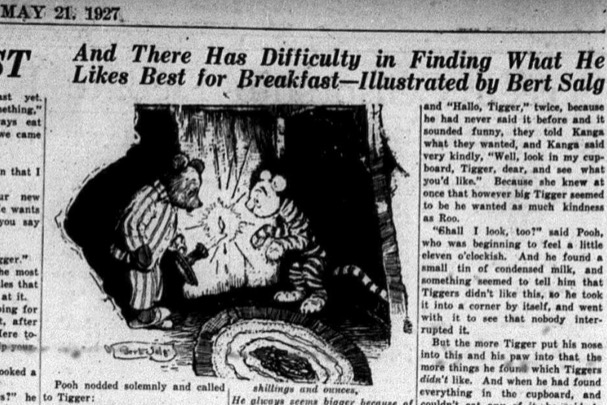
Tigger doesn’t appear in it, nor did he in Winnie the Pooh. He debuted in “Tigger Comes to the Forest”, published in the New York Post in May 1927. Bert Salg draws him differently there than he looks in 1928’s House at Pooh Corner. But this copyright-unrenewed version is US-public domain now.
December 13: Harry Woods’s songs, though nearly a century old, remain vital today. “I’m Looking Over a Four-Leaf Clover”, written with Mort Dixon, is a #Philadelphia staple, performed by #Mummers bands (see e.g. this Quaker City String Band performance) and sung by Union soccer fans.
And a couple I’m friends with adopted Woods’s “Side by Side” as their song, dancing to it at their wedding reception and keeping a framed record of it in their home.
December 14: “It is my suspicion that the universe is not only queerer than we suppose, but queerer than we can suppose.”
That’s one of the most memorable quotes of JBS Haldane, a scientist who also wrote extensively for the British popular press. It’s from the title essay of the 1927 collection Possible Worlds and Other Papers. Tim Radford writes here on the book, and on Haldane’s talents and flaws. It joins the US public domain in 18 days. #PublicDomainDayCountdown#Bookstodon
December 15: The University of Washington Dance department has resources on the life and work of Isadora Duncan, the “mother of modern dance”.Duncan revolutionized #dance, upending ballet’s rigid rules of choreography and costume in favor of free-flowing and naturalistic sequences and dress. She also defied social convention in her personal life.
Published shortly after her death in 1927, Duncan’s autobiography My Life joins the public domain in 17 days. #PublicDomainDayCountdown
December 16: My #PublicDomainDayCountdown spotlights individual works, but the sheer number of works newly free to explore and analyze as a corpus is a treasure in itself.
John Livingston Lowes took advantage of a such a treasure in The Road to Xanadu. Lowes read every book he could find that Samuel Taylor Coleridge had, to show how his voracious reading nourished two of his great poems. Toby Litt calls it “a get-completely-lost-in-it book.” It joins the public domain in 16 days.
December 17: “it’s a PLAY, so let it PLAY with you… let it go all around and over and under you and inside you and through you. Relax… stop wondering what it’s ‘about’—like many strange and familiar things, Life included, this PLAY isn’t ‘about,’ it simply is.”
December 18: When Ludwig Lewisohn was pursuing a PhD, he was told “the chances are going to be greatly against you” in getting a professorship due to his “Jewish birth”. As Josh Lambert writes, the then highly assimilated Lewisohn “took this situation personally”. His 1927 “great American Jewish novel” The Defeated (published later as The Island Within) exhorts Jews to reject assimilation and embrace their identities. It goes public domain in 2 weeks. #PublicDomainDayCountdown
Hannah R. London’s 1927 book Portraits of Jews by Gilbert Stuart and Other Early American Artists shows and discusses many more portraits like this. It joins the public domain in 13 days. #PublicDomainDayCountdown
December 20: Duke’s Center for the Public Domain has now posted “What Will Enter the Public Domain in 2023?”. Jennifer Jenkins wrote their annual article, and it’s well worth reading both for the works and the commentary.
Among the works noted there is The Lodger, Alfred Hitchcock’s first suspense film. It incorporates numerous themes he’s known for in later films, as Andy Wolverton shows. It joins the US public domain in 12 days. #PublicDomainDayCountdown
December 21: Manvir Singh’s article on the Huxleys describes Julian Huxley’s Religion Without Revelation as built around controlling “a cosmic process that produces ever-greater intelligence and complexity”. Julian’s philosophy has enthralled some (with recent variants involving AI more than eugenics) and horrified others, including his brother Aldous, whom Singh suggests wrote Brave New World as a rebuttal. Julian’s book goes public domain in 11 days. #PublicDomainDayCountdown
December 22: Like her character, Lucy Maud Montgomery was torn about what choices Emily Starr should make in her life, including whether and how to pursue her passion to write, and which of her suitors, if any, she should marry. This article suggests how the character and her author ultimately made those choices in Emily’s Quest, the final book of Montgomery’s Emily of New Moon trilogy. The book joins the US public domain in 10 days. #PublicDomainDayCountdown#Bookstodon
December 23: “Caedit nos pestis” (“The plague is upon us”) are the first words sung in the oratorio/opera Oedipus Rex. It premiered in Paris in 1927, with music written by Igor Stravinsky, and libretto translated into Latin by Abbé Jean Daniélou from French text written by Jean Cocteau. In 2021 it was the LA Opera’s first performance after coming out of COVID lockdown. The 1927 #oratorio joins the public domain in 9 days. #PublicDomainDayCountdown
December 25: The life of Jesus is presented as a big-budget Hollywood epic in Cecil B. DeMille’s The King of Kings, first released in 1927 as a 155-minute silent film mostly in black and white, with Technicolor used for the resurrection scene. Gordon Thomas discusses the movie, and strengths of the 1927 release compared to later versions DeMille released, for Bright Lights Film Journal. It joins the public domain one week from today. #PublicDomainDayCountdown
December 26:Ross Altman writes “Has any other individual had such a singular impact on the broad sense of American folk music, song and story as Carl Sandburg? [Others] collected cowboy songs, or Negro spirituals, or sea shanties, but Sandburg collected them all, and saw the big picture of what they represented—as he rightly and first called it: The American Songbag—the songs of the people.” Sandburg’s 1927 collection will belong to the people in 6 days. #PublicDomainDayCountdown
December 27: A number of famous figures in crime fiction have appeared in my #PublicDomainDayCountdown this year. A less obvious figure who played a key role in the flowering of the genre’s Golden Age is T.S. Eliot. In 1927 he started featuring crime fiction reviews prominently in his literary magazine The Criterion, and wrote an influential list of rules for detective stories. His 1927 criticism, and many of the stories he reviewed in the magazine, join the public domain in 5 days.
December 28: In 1927, Duke Ellington’s orchestra began a residency at New York’s Cotton Club that lasted 4 years. Their live and radio shows soon made Ellington’s style of #jazz nationally famous. Ellington and trumpeter Bubber Miley collaborated on a number of the group’s early hits, including “Black and Tan Fantasy” and “East St. Louis Toodle-O”, featuring Miley’s growly muted trumpet sound. Both songs join the public domain in 4 days. #PublicDomainDayCountdown
December 29: Dhan Gopal Mukerji was asked to hide outside the 1928 Newbery ceremony before the award was announced, lest his presence among an overwhelmingly white crowd give away the winner in advance. He was the only Newbery medalist of color until the 1970s. Pooja Makhijani writes on the beauty of his book Gay-Neck: The Story of a Pigeon, and on the squelched opportunities for more books like his. Gay-Neck joins the public domain in 3 days. #PublicDomainDayCountdown
December 30: A sober remembrance, before we celebrate #PublicDomainDay in 2 days, for works scheduled to join the public domain that didn’t survive this far. This year they include the 1927 films London After Midnight, a million dollar grossing film starring Lon Chaney, and The Way of All Flesh, whose lead actor’s performance was cited in his Oscar win. Causes of demise include lack of copies outside creators’ control, and long #copyright terms keeping others from making copies. #PublicDomainDayCountdown
December 31: “…and Ol’ Man River, he’ll just keep rollin’ along.”
“Ol’ Man River” joins the public domain tomorrow. Show Boat joins it in a year. Later, so will their changes, and countless other works, as long as the public domain keeps rolling along. #PublicDomainDayCountdown
When I first created Banned Books Online over 25 years ago, I wasn’t primarily worried about book censorship. I was worried about Internet censorship.
It was 1994, and the world at large was just getting to know the Internet, which not long before had been a network mostly limited to researchers, information technologists, and students and faculty at universities. After an undergraduate at my university wrote about pornography on the network (in a paper that would become the basis of a sensationalist Time magazine cover story the following year), our administration decided it needed to censor Usenet, a system of online discussion forums that then comprised the predominant social media of the online world. Specifically, Usenet forums discussing sex had to go. One of the administrators behind the decision was an English professor who in an interview praised James Joyce’s Ulysses, a groundbreaking novel still enjoyed and studied a century after its initial publication. But that publication had been banned for years, both in the US and elsewhere, due to the novel’s discussions and allusions to sex. I thought at the time, “if the Internet goes the way you want it to go here, no one will ever be able to publish Ulysses or anything like it online going forward.” Banned Books Online started as a way to reify that thought, and to demonstrate what we would lose in a heavily censored Internet.
I’m glad to say that, while there are still free speech battles to be fought on the Internet, pervasive censorship of the open Internet to something resembling the standards of broadcast TV (which some of us feared the mid-1990s panic might lead to) didn’t happen– at least not in the United States. But other forms of censorship have had a resurgence since then. That includes book censorship, which I largely treated in my exhibit as a relic of the past. “We used to ban books frequently years ago,” I implicitly argued in the exhibit, “and maybe there are still some isolated pockets of people trying to ban books even now. But we’ve moved beyond that today, and we enjoy a richer, freer culture because of that. So let’s not repeat our past mistakes on this new Internet”. That was the implication I had in mind.
But it’s become increasingly clear that my early optimism about the waning of book bans was misplaced. Book bans and ban attempts have surged in the US in recent years, particularly in schools (as PEN America documents) and libraries (as the American Library Association documents). As PEN America’s report notes, they’re now often not just isolated local affairs, but are driven by campaigns coordinated by nationally active advocacy groups. They’re often targeting books that feature LGBT viewpoints or that bring up issues of racism and injustice. They’re backed up by prominent politicians, some of whom proudly announce their intention to “ban critical race theory” (often defined vaguely enough to effectively mean “issues that make white people uncomfortable”) or to prohibit classroom discussion of sexual orientation beyond heterosexuality, or gender identities other than masculine and feminine ones assigned at birth.
In some cases, reports of attempts to ban specific famous titles in schools and libraries can increase their sales and visibility elsewhere. (Though in some cases, booksellers have also been threatened with prosecution for putting targeted titles on open shelves.) But broad ban lists, such as ones that cover hundreds of recent titles, can prevent many lesser-known books and authors from the chance to find their audience in the first place. They can discourage publishers from acquiring or releasing such books. They can also dissuade libraries from offering them, lest they get defunded if they carry books that some people don’t like.
My priorities for a banned books exhibit have changed accordingly. I want to draw attention to books under threat now, even when they’re not old enough to be in the public domain, and don’t have an authorized free online edition I can link to. I want to help people find copies they can read, in libraries and from booksellers, and I want to encourage support for those libraries and booksellers, so they hear from people who love the books and want to read them, and not just from those who want them gone. I want to show how and why books get targeted for bans both in the past and in the present, and understand the common themes that recur in these banning attempts, and in other manifestations of authoritarianism. And while library and school bans get the most press attention in the US, I also want to ensure that people don’t forget more pervasive book censorship in American prisons, and in other countries around the world. From a more technical standpoint, I’d also like to tap into the growth of linked open metadata to connect readers with information about books of interest to them, and with libraries that offer them.
So with that in mind, I’m now developing a new exhibit, Read Banned Books. I’m opening it to public preview on Banned Books Week 2022. It’s still under development, and I’ve just started to populate its collection, but it will grow over the course of this week and in the weeks that follow. The metadata and commentary in the collection will be shared on Github, and I hope it can be reused and applied in novel ways both by my site as it develops, and by others. While I don’t plan to try to make a comprehensive data set of all banned books and banning attempts, I do hope to highlight particularly important and interesting books and incidents, and to link to broader dossiers of censorship on other sites.
I invite you to check it out, and to let me know about useful things I can add to its knowledge base and functionality. And I hope you’ll be informed and active in resisting censorship and authoritarianism in this new era.
The Piglet lived in a very grand house in the middle of a beech-tree, and the beech-tree was in the middle of the forest, and the Piglet lived in the middle of the house. Next to his house was a piece of broken board which had “TRESPASSERS W” on it. When Christopher Robin asked the Piglet what it meant, he said it was his grandfather’s name, and had been in the family for a long time, Christopher Robin said you couldn’t be called Trespassers W, and Piglet said yes, you could, because his grandfather was, and it was short for Trespassers Will, which was short for Trespassers William. And his grandfather had had two names in case he lost one–Trespassers after an uncle, and William after Trespassers.
— A. A. Milne, “Winnie-the-Pooh”, now in the US public domain
It’s good to be celebrating another Public Domain Day. It’s especially good this year in the US, where we get an especially rich set of arrivals to the public domain. They include as many as 400,000 sound recordings from the invention of recording through the end of 1922. They also include many thousands of publications from 1926, including classics like Winnie-the-Pooh, quoted above. (See my just-finished public domain countdown for a selection of other interesting works joining the US public domain.) Most other countries have public domain arrivals to celebrate as well. In countries like those in Europe with “life+70 years” copyright terms, those include works of authors who died in 1951, and in countries like Canada that still have “life+50 years” terms, they include works of authors who died in 1971. (Some notable authors who died in those years are featured in the Public Domain Review’s Public Domain Day 2022 article.)
As I’ve thought about Winnie-the-Pooh today, I’ve been drawn back to the quote from it above. Much of Milne’s dry humor in it (and elsewhere in the book) was aimed at older readers, and flew over my head when I first read it as a child. I didn’t know that the “Trespassers W” sign was the remnant of someone trying to claim ownership over the land the characters inhabit. All of the characters in the book, likewise, are completely oblivious to that claim. They freely wander over the Hundred Acre Wood and surrounding countryside without any regard to private property claims. Instead, as seen above, they assume a completely different and absurd reason for the claim-staking sign.
Now that the book is in the public domain, we too can revisit and reuse the setting and characters of the book as we like. But the value of the intellectual property claims related to Winnie-the-Pooh make it important for us to watch our steps carefully. Pooh is one of the most valuable characters in the portfolio of the Walt Disney Company, and this book’s entry to the public domain was delayed 39 years, in part because of Disney’s lobbying of Congress. They still control rights to the designs of Pooh and friends in their animated cartoons (recognizably different from the original designs by Ernest Shepard), to the characters that don’t appear in the 1926 book (including Tigger, who shows up in its sequel), and to trademarks covering all manner of Pooh-related merchandise.
In a blog post at Duke’s Center for the Study of the Public Domain, Jessica Jenkins discusses the rights Disney can still assert over Winnie the Pooh and friends. She also discusses how other rightsholders have wielded control over any use of characters that they claim is “too close” to their own expressions. For instance, the estate of Arthur Conan Doyle got Netflix to make a deal with them for the use of Sherlock Holmes, a character who’s long been in the public domain, over claims that their movie Enola Holmes reused copyrightable aspects of Holmes that only appear in the last few stories that were still under US copyright. The character copyright claims of the estate are dubious, but the estate’s been litigious enough that I could easily see how a filmmaker would prefer to settle with the estate rather than undergo a long and costly lawsuit, even if it were likely to eventually get a favorable ruling.
Similarly, it’s possible that Disney and other rightsholders could chill reuse of public domain works by making legal threats against anything they claim is “too similar” to their own products. Similar concerns over the character Bambi are a reason that new translations of Felix Salten’s original novel are only being released today, when it is finally unquestionably in the public domain in all major global markets. There are arguments to be made that Bambi has already been in the public domain for a few years at least, but due to the complicated litigation history, many have been reluctant to make use of the character until its 1926 US registration expired and made those arguments moot.
As I went walking I saw a sign there And on that sign it said “No Trespassing.” But on the other side it didn’t say nothing. That side was made for you and me.
— Woody Guthrie, “This Land Is Your Land”, as published on his official website
What can we do to protect the public’s right to enjoy and reuse what’s rightfully theirs to use, when others want to monopolize them? For one, we can boldly and publicly make full use of the parts of our cultural heritage that are not truly covered by “No Trespassing” claims, the sides that, as the verse above says, were “made for you and me”. We can assert and exercise the right to use the public domain, even in the face of challenges to it. Whether those assertions result in court victories(which blunted even more expansive claims over Sherlock Holmes by the Conan Doyle estate in 2014), or in implicit peace treaties (like the willingness of Guthrie’s rightsholders to liberally license “This Land is Your Land” without admitting to public domain status), our affirmations of the public domain make it safer not only for us to use, but for others to use as well.
Affirming the public domain motivates projects like HathiTrust’s Copyright Review Program, the New York Public Library’s U.S. Copyright History Project, as well as Penn’s Deep Backfile Project for serials that I manage. We’re all trying to make it easier to identify and open access to works newer than 95 years old that are in the public domain (but not obviously so) so that people can feel more secure reproducing and reusing them.
Fair use is important to defend as well. I can quote the verse above from “This Land is Your Land”, despite it not being in the 1945 publication of the song that EFF has convincingly argued is in the public domain, and despite often-repeated folk advice to never quote song lyrics without permission. I’m using a limited portion of the song analytically to help make a point in my argument about public rights, and my use is not likely to substitute for, or hurt the market for, the song itself. (Guthrie’s own words also suggest he’d be happy with my use.) In other words, I’m exercising fair use. And when we exercise fair use, we keep it from atrophying, and preserve it as an “essential part of our political and cultural life”, and an important protection of free expression.
We also may need to work to protect all the sound recordings that just entered the public domain from claims that now have no more validity than the remnants of the sign outside Piglet’s door. Many of the major Internet platforms have mechanisms to automatically flag audio that seems to be derived from commercial recordings, and block them, demonetize them, and impose copyright strikes against the people who post them, Up until now, platforms could generally safely assume that recordings that have ever had a valid copyright claimant always have one. But now there are hundreds of thousands of recordings that once had a claimant, but now belong to the public at large. We need to make sure that platforms recognize and respect those new public rights. If past experience is any guide, public vigilance and outcry over improper takedowns will help ensure that happens.
This Public Domain Day gives us much to celebrate, and to use, in all kinds of educational, entertaining, and creative ways. To make the most of it, we have to resolve and work to protect it from those who would try to monopolize public rights for themselves. While some may still call us “trespassers” when we make full use of public domain, fair use, and other public rights, our will to persist in those uses helps bring the copyright system into a healthier balance, promoting the well-being of creators and audiences alike.

 RSS feed
